Sunday, 5 May 2013

Weekend in Pondicherry

Pondicherry, the slice of french riviera on the Bay of Bengal seaside is not a usual tourist destination. This is one place where you do not want to zip through the 'to see places' but soak in the tranquil and laid back atmosphere, the french and Tamil architecture, marvel at the restored old mansions and houses and conjure up a wish of living the rest of your life in one such mansion practically doing nothing. Life is unhurried here in the French quarter or the White Town, which the french built so lovingly, creating the typical french ambiance, look an feel and the cuisine.


A weekend in Pondicherry though too short a time to enjoy the town which practically does not boast of any landmark tourist site, yet for me one has to live here for weeks to really savor the town called Puducherry.


One may ask, what is there to see in a town which runs barely a couple of kilometers on the sea front. Where the seashore does not transform into a sandy beach. What is there to see and do here? To such touristy folks, I have to say thus. Puducherry is not a beach town but a seaside town. There is simplicity and refinement in its heritage hotels, cuisine, crafts and even the street signs, which you never get to see anywhere else in India. No place in India can boast of its street names and signage written in French and the local language - that too neatly marked at every street corner. Not in English.


The day begins with being one with nature meditating on the seashore's boulevard dotted with numerous black boulders to keep the mighty waves away. Some moments spent in yoga, pranayam, or simply watching the wobbling fishing boats tossed up by the gigantic waves and the crimson sun waking from the  night's slumber are bliss moments. The early morning breeze, the sea waves and the tranquil only broken by splashing waves and cries of crows, chirping of birds can soothe the minds of any ravaged city soul in search of the "own moment".


Walk the french town early morning or late evening. Every lane and bye lane offers sights which softens the weary soul. Mustard painted mansions laden with bougainvilleas look extra ordinary.


The glitzy city buildings pale in comparison to these old beauties which have withstood the ravages of time and look strong enough to last few more centuries.


Neat straight streets with its both sides flanked with rows of mansions and houses, some converted into boutique hotels, some into quaint restaurants and art shops. Many of these under the Aurobindo Society serving as residences for their inmates who come in large numbers from across the world in search of human equality and peace.


Street signage in Tamil and French


Best way to savor Pondicherry is by foot or hire a bicycle or for that matter scooter which are available aplenty from hire shops or you can ask your hotel they would arrange one. White town is best explored on bicycle if you do not wish to strain your legs. Obviously, this also happens to be the preferred mode of conveyance for the White Town folks including the Ashram inmates and visitors. One could see men and womenfolks of all age commuting on this humble mode of transport - healthy way of living, inexpensive and eco-friendly.

 The stay options in the French quarter ranges from the modern The Promenade right on the boulevard near the Light House to Hotel De L'Orient - a heritage hotel from the Neemrana house.
But for me, the place that certainly provides the solitude, serenity, bliss and my own space has to be the Gratitude on the leafy Rue Romain Rolland. # 52 it is. The ochre colored two story old mansion which has seen some 150 odd years since it came up has been recently converted lovingly into a home for people who do not hanker for the modern luxury of a star hotel. Kakoli and her team deservedly proud of their property, which they call their home.


Few days spent here in this informal home either lazing on the antique bed, curling up on the comfy sofa with that book that you always wanted to read but never got the time, penning your thoughts sipping tea by the courtyard under the tall mango tree, looking at the sky swinging on the swing by the courtyard or getting treated with traditional massage are some of the things that you could do here.


Ochre color casts a sense of warmth and being at Home at Gratitude

Tea and coffee is available round the clock. Choose your tea and the famed Auroville Pottery cup from the assortment.

The gong which is rung to announce breakfast time. Breakfast at Gratitude is communal time, where all residents gather and partake the home-made food served from the kitchen and lovingly prepared by the house staff. Choose from the delicious Dosas, omelets, multi grain breads, fresh fruits, organic preserves, muesli and flakes and of course tea or coffee.This is one time when all residents meet and discuss their plans for the day and also share details of who they are and what brings them here. This trait of Gratitude reminds me of the vanishing tradition of our homes when at the break fast or dinner table all family members must be present. Leave your shoes at the shoe rack near the entrance. This is another trait which reminds us of our home.  
Warm glow of the bedside lamp reflects soothingly on the fine bed furnishing

The tall mango tree above and birds frolicking on fruit laden branches provides enough inspiration for the creative mind.

The colonnade and the courtyard. All rooms open to the central rectangular courtyard

Curl up with the book that you always wanted to read.The long corridor on first floor provides that ambiance which stimulates creativity. Every nook and corner  here displays tasteful craft and art handpicked by the owners. The cushioned chair here, down the veranda another chair to laze around. Old portrait on the wall, wrought iron chairs in the courtyard, the bull statue in the ground floor veranda, the flower mural in the boutique, the ceramic red rooster on the dining table, small nick knacks here and there. The refreshing soap from Auroshikha in the en suite bathroom, the jasmine flowers in urli and the inviting flower vase at the doorway all placed to enhance the charm of this place. Gratitude is certainly a Home away from Home and the one which will always beckon me to this french Riviera.                                                                                 

Pondicherry is not only about the white town. The Black Town or the native town is equally beautiful and full of sights and sounds which are in complete contrast to the french town. The charming Tamil mansions of Vysial street, the old Goubert Bazar and its all women fish market and the characteristic manners of these feisty women are some of the sights and sounds that one should not miss.

The charming lady fishmonger at the all women fish market at Goubert Market

Old Tamil mansion on Vysial Street with its trademark Thenni, the shadowy corridor which served as place for resting and gossip for the house owners, neighbors and passer-byes

Walk down to the Ashram Paper Factory on S V Patel Road for handmade paper and paper products made at this factory run by the Aurobindo Society. One always comes out of this premises with loads of paper products. 

Muslim Mansion on Rue Cazy

The Muslim Quarters of Rue Cazy, Rue Chanda Sahib and Rue Mulla presents charming example of French-Tamil architecture. The old mansions here have the ground floor built in the traditional Tamil architectural vernacular while the upper storey is built in French architectural style.  

Rooftop cafe at Kaasha ki Aasha
Kaasha ki Aasha on Rue Surcouf not only is a fine craft boutique housed in an old Tamil mansion but also runs a fairly good rooftop cafe. Full of easy bamboo loungers, deep cushions and green plants. Ideal for curling up with the favorite book over a quick bite or tea. The kitchen and store is run by women here.

For an authentic Creole meal in a fine ambiance one has to be at Carte Blanche at Hotel De L'Orient  on Rue Romain Rolland, few blocks away from the Gratitude. The food here is top of the rank and the ambiance just perfect for an evening meal. Colonnaded breezy courtyard, greenery all around, flowering plants and the authentic creole cuisine is signature of this place owned by the Neemrana group.  

Carte Blanche at Hotel De L'Orient

For the authentic Pondicherry and wholesome meal my favourite would be Madam Shante again on Rue Romain Rolland. 

While in Pondicherry one certainly gets impressed with the nattily attired policemen with their trademark red cap         Kepi. They are certainly a proud lot.                       Coodinates:   Gratitude on 52 Rue Romain Rolland. http://www.gratitudeheritage.in.                                      Nearest Airport - Pondicherry, but only limited flights land here. Chennai is the nearest airport with easy connectivity.    Chennai to Pondicherry can be covered by road in approx 2.5 hours. Taxi fare from Chennai - About Rs.3,000/- for air conditioned car. Book with Gratitude, will cost less.                                                                   Banks and ATM - Citbank branch on Rue Bussy. Other Bank ATMs nearby.                                                                 Fast food Restaurants - Pizza Hut on Bussy Street, KFC on M G Road.                                                                 244 Hour Cafe - Le Cafe on Beach Road                            Crafts & Shopping - Boutique de Auroville, Kalki, Hidesign, Casablanca - all on and around J L Nehru Road. Auroshikha at Rue de LaMarine for soaps and agarbattis, Kaasha ki Aasha on Rue Surcouf for crafts, Arumai on M G Road for pottery, Linen World on Mission Street for  men's and women wear in linen fabrics       


Saturday, 13 April 2013

Bharat Bhavan Bhopal - Multi Cultural Centre

If there is one cultural complex in India that stands out both as a piece of great architecture, treasure trove of Indian art and a vibrant platform for display of drama, music, art, dance and other forms of art then Bharat Bhavan of Bhopal stands out. 
    Panoramic view of the Bhopal lake and old city from the terrace of Bharat Bhavan
    Blue tiled domes on the terrace of Bharat Bhavan

    Enchanting inner courtyard- space for creative adda

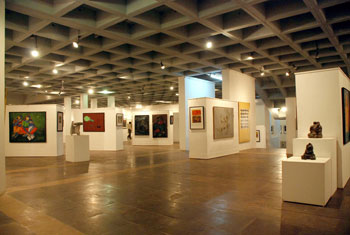
This multi-art center was established and funded by the government of Madhya Pradesh and the master architect Charles Correa was entrusted to design and build the center on the Shamla Hill by the lake at Bhopal. The location certainly inspired and provided the architect with a classic space where he could play around with the natural elements and create a free flowing, terraced space that exudes openness. Bright and sunny spaces, terraced gardens which cascades down to the edge of the lake, open courtyards, amphi-theatre, galleries with high ceiling, smooth flow of air and sunlight lit enclosures adds to the charm of this cultural arena.

The centre was inaugurated in 1982 by the Prime Minister of India, Indira Gandhi, since then Bharat Bhavan has seen some glorious days and not so good ones too. The centre was once run by the great masters of Indian art, literature and culture.   

    Gond Painting - Earthy, simple yet elegant
Gond Painting
Masters like J Swaminathan, Habib Tanveer, Kumar Gandharva, Sonal Mansingh, B V Karanth, Ajneya, Syed Hyder Raza, Manit Bawa and Ashok Vajpeyi have been actively associated with running of the centre in the past. Their honest interest in developing an alternate to Delhi as cultural hub of India has been success to a certain extent and could have been more only if there would have been less of political interventions in managing of the centre.

    Painting by J Swaminathan
Another painting of J Swaminathan
The activities of the centre are organized through various wings. Roopankar is the Museum of Fine arts, Rangmandal - a Repertory, Vagarth - a centre for Indian Poetry, Anhad - for classical and Folk music and Chhavi for Classical Cinema.
   
s 

The collection of contemporary art at Bharat Bhavan is no mean in number or standard. works of J Swaminathan, S H Raza, M F Hussain, F N Souza, Ghulam Mohammed Sheikh, Manjit Bawa, Tyeb Mehta, Jehangir Sabavala, Ramkumar, Akbar Padamse, Vivan sundaram, Bikash Bhattacharya, Jogen choudhary, Prabhakar Kolte, V S Gaitonde, Satish Gujral, K K Hebbar, N S Bendre, Krishan Khanna, Bal Chavda, Ambadas, Vishwanathan, Amitava Das, Madhavi parekh, Akhilesh and many others are on permanent display here.  

The galleries are open on all days from 10 am to 6 pm. One can watch plays, musical soires, mushaira and other cultural programmes which is organized on regular basis. The annual Drama Festival is a marquee event here.


Jaipur Literature Festival 2013 - Literary Stars descend on Pink City

Jaipur Literature Festival 2013 has mastered the art of raising controversies of one kind or another. Last year it was Rushdie who attracted undue attention and this year when it looked things would sail through smoothly came the remark by social commentator Ashish Nandy. Notwithstanding the controversy this edition of J-LitFest would be recalled for several highs that it achieved over the 5 days of literary extravaganza.

Michael Sandel, the rockstar professor from Harvard enthralled the packed audience in the two sessions that he participated in - 'What Money Can't Buy' and 'If Rape is the Most heinous crime'.  The mixed audience of academics, literature buffs, writers, housewives and children enthusiastically participated in both the sessions. He truly democratized the sessions. My guess is he acted as an anchor rather than a monologue professor and carried the audience with him to the logical conclusion of the issues that he discussed. Assertion of a lady participant from Mumbai - "I do not need virginity but my limbs to live a dignified life" during his debate on "If Rape is the most heinous crime" told a million tales about what Indian women want today.


The arguments that flew thick and fast between the speakers and poet, lyricist Javed Akhtar during the session on Caste and Religion and the audience engaging in the discussion goes long way to prove that freedom of expression has certainly come of age in India and JLF is one such forum which provides ample opportunity for thinkers to express their view freely and for the common audience to counter and question the argument put forth by the authors.

Prasoon Joshi and Shabana Azmi engaged in what sounded like monologue to me deriding the vulgar portrayal of women in Hindi cinema and the rising trend of raunchy 'item numbers' and 'item songs' being added in the hindi movies to make the film sell-able. I would have appreciated, if they could expand their view point beyond the Hindi cinema with which most of the audience are largely acquainted with. Blaming the audience for the growth of vulgarity can not be put squarely on the audience. The film makers are also largely to be blamed. The thinkers should have known that till sixties and early seventies love and romance had a different meaning and imagery in Hindi Cinema and things changed from 70's not because the audience wanted it but because the film makers started serving trashy remakes of south Indian films. The film makers lost their way in early eighties certainly.
Shabana Azmi and Prasoon Joshi in conversation with Sanjoy Roy, the organizer of JLF

   
Shabana Azmi putting across her views about portrayal of women in Hindi Cinema and the vulgarization of songs and dance.

Baithak, the grand Hall of the palace is a good venue for Baithak but bad for acoustics. Authors had difficulty in connecting with the audience with faulty lighting and sound system. Here the Sri Lankan author reading from his book Serependity.


Author William Darlymple, the brain behind JLF in conversation with a journalist. This photograph aptly portrays the informal air of JLF. Here no one is a VIP and no one gets a seating preference, however powerful you may be, if you're not the author participating in the session, you find a place for yourself in the area for audience and make yourself comfortable. Such contrast with the "You don't know me" refrain of Delhi.

                                                         Festive look of the Festival venue

    Sharmila Tagore, Malashree Lal, Nasreen Munni Kabir listening to Jeet Thayil during  the DSC South Asian Literature Award ceremony conducted by actor Kabir Bedi


    Glamour quotient was not missing from JLF. Sunanda Pushkar seen here talking to Sharmila Tagore

    Sharmila Tagore in conversation with the renowned film writer Nasreen Munni Kabir, talking about her journey into the world of cinema through films of Satyajit Ray. 

   The attendance at JLF 2013 surpassed its previous best with about 3 lakh people attending it over the 5 days. The festival venue wore a festival look where acclaimed authors and thinkers mingled freely with the common people.


Jeet Thayil won the DSC South Asian Literature Award for his Mumbai centric novel Nacropolis. The award comes along with a prize money of 50,000 us dollars. 'Nacropolis edged past Jamil Ahmed's 'The Wandering Falcon', Tahmima Anam's  The Good Muslim, Amitava Ghosh's River of Smoke, Mohammed Hanif's Our Lady of Alice Bhatti and The Walls of Delhi by Uday Prakash. All fine wordsmiths! Jeet after receiving his award from film actress Sharmila Tagore and Bhanwri Devi, the lady who fought for justice after subjected to rape in a Rajasthan village. Her fight against cruelty against women led to the now famous Bhanwri Devi judgement by the Supreme Court of India which is a landmark judgement for dealing with cruelty against women. Her presence at JLF was symbolic of the mood that prevails in India today.


Notice  the Monroe print dress of Oscar Award winner Pakistani film maker articulating if Pakistan qualifies to be branded as a 'Failed state'. Moderated by Barkha Dutt, the leading TV journalist of NDTV Group had a tough time making the panelist agree even to the definition of a 'failed state'. The panelist with as broader representation as Pakistan, Lebanon, Palestine and Iran, however were of the view that the Americanized definition of a failed state is not the only definition. Somalia may be a filed state, but Pakistan or for that matter India is certainly not a failed state and there is hope for the world despite the sense of despair.

To catch the next round of JILF in Jan 2104, plan in advance. Accommodations become scarce in Jaipur during this 5 day festival. My recommendation is Hotel Arya Niwas off MI Road on Sansar Chand Road   built in a renovated haveli, it offers all modern amenities while retaining the old age charm, greenery and feeling of space. Passionately run by the owner family, Arya Niwas aims to provide comfortable stay in elegant surroundings at reasonable prices. Write / call them for booking in advance since they are favourites of Literature buffs.   +91 141 407 3450, +91 98290-40549.