Saturday, 13 April 2013

Bharat Bhavan Bhopal - Multi Cultural Centre

If there is one cultural complex in India that stands out both as a piece of great architecture, treasure trove of Indian art and a vibrant platform for display of drama, music, art, dance and other forms of art then Bharat Bhavan of Bhopal stands out. 
    Panoramic view of the Bhopal lake and old city from the terrace of Bharat Bhavan
    Blue tiled domes on the terrace of Bharat Bhavan

    Enchanting inner courtyard- space for creative adda

This multi-art center was established and funded by the government of Madhya Pradesh and the master architect Charles Correa was entrusted to design and build the center on the Shamla Hill by the lake at Bhopal. The location certainly inspired and provided the architect with a classic space where he could play around with the natural elements and create a free flowing, terraced space that exudes openness. Bright and sunny spaces, terraced gardens which cascades down to the edge of the lake, open courtyards, amphi-theatre, galleries with high ceiling, smooth flow of air and sunlight lit enclosures adds to the charm of this cultural arena.

The centre was inaugurated in 1982 by the Prime Minister of India, Indira Gandhi, since then Bharat Bhavan has seen some glorious days and not so good ones too. The centre was once run by the great masters of Indian art, literature and culture.   

    Gond Painting - Earthy, simple yet elegant
Gond Painting
Masters like J Swaminathan, Habib Tanveer, Kumar Gandharva, Sonal Mansingh, B V Karanth, Ajneya, Syed Hyder Raza, Manit Bawa and Ashok Vajpeyi have been actively associated with running of the centre in the past. Their honest interest in developing an alternate to Delhi as cultural hub of India has been success to a certain extent and could have been more only if there would have been less of political interventions in managing of the centre.

    Painting by J Swaminathan
Another painting of J Swaminathan
The activities of the centre are organized through various wings. Roopankar is the Museum of Fine arts, Rangmandal - a Repertory, Vagarth - a centre for Indian Poetry, Anhad - for classical and Folk music and Chhavi for Classical Cinema.
   

The collection of contemporary art at Bharat Bhavan is no mean in number or standard. works of J Swaminathan, S H Raza, M F Hussain, F N Souza, Ghulam Mohammed Sheikh, Manjit Bawa, Tyeb Mehta, Jehangir Sabavala, Ramkumar, Akbar Padamse, Vivan sundaram, Bikash Bhattacharya, Jogen choudhary, Prabhakar Kolte, V S Gaitonde, Satish Gujral, K K Hebbar, N S Bendre, Krishan Khanna, Bal Chavda, Ambadas, Vishwanathan, Amitava Das, Madhavi parekh, Akhilesh and many others are on permanent display here.  

The galleries are open on all days from 10 am to 6 pm. One can watch plays, musical soires, mushaira and other cultural programmes which is organized on regular basis. The annual Drama Festival is a marquee event here.


Jaipur Literature Festival 2013 - Literary Stars descend on Pink City

Jaipur Literature Festival 2013 has mastered the art of raising controversies of one kind or another. Last year it was Rushdie who attracted undue attention and this year when it looked things would sail through smoothly came the remark by social commentator Ashish Nandy. Notwithstanding the controversy this edition of J-LitFest would be recalled for several highs that it achieved over the 5 days of literary extravaganza.

Michael Sandel, the rockstar professor from Harvard enthralled the packed audience in the two sessions that he participated in - 'What Money Can't Buy' and 'If Rape is the Most heinous crime'.  The mixed audience of academics, literature buffs, writers, housewives and children enthusiastically participated in both the sessions. He truly democratized the sessions. My guess is he acted as an anchor rather than a monologue professor and carried the audience with him to the logical conclusion of the issues that he discussed. Assertion of a lady participant from Mumbai - "I do not need virginity but my limbs to live a dignified life" during his debate on "If Rape is the most heinous crime" told a million tales about what Indian women want today.


The arguments that flew thick and fast between the speakers and poet, lyricist Javed Akhtar during the session on Caste and Religion and the audience engaging in the discussion goes long way to prove that freedom of expression has certainly come of age in India and JLF is one such forum which provides ample opportunity for thinkers to express their view freely and for the common audience to counter and question the argument put forth by the authors.

Prasoon Joshi and Shabana Azmi engaged in what sounded like monologue to me deriding the vulgar portrayal of women in Hindi cinema and the rising trend of raunchy 'item numbers' and 'item songs' being added in the hindi movies to make the film sell-able. I would have appreciated, if they could expand their view point beyond the Hindi cinema with which most of the audience are largely acquainted with. Blaming the audience for the growth of vulgarity can not be put squarely on the audience. The film makers are also largely to be blamed. The thinkers should have known that till sixties and early seventies love and romance had a different meaning and imagery in Hindi Cinema and things changed from 70's not because the audience wanted it but because the film makers started serving trashy remakes of south Indian films. The film makers lost their way in early eighties certainly.
Shabana Azmi and Prasoon Joshi in conversation with Sanjoy Roy, the organizer of JLF

   
Shabana Azmi putting across her views about portrayal of women in Hindi Cinema and the vulgarization of songs and dance.

Baithak, the grand Hall of the palace is a good venue for Baithak but bad for acoustics. Authors had difficulty in connecting with the audience with faulty lighting and sound system. Here the Sri Lankan author reading from his book Serependity.


Author William Darlymple, the brain behind JLF in conversation with a journalist. This photograph aptly portrays the informal air of JLF. Here no one is a VIP and no one gets a seating preference, however powerful you may be, if you're not the author participating in the session, you find a place for yourself in the area for audience and make yourself comfortable. Such contrast with the "You don't know me" refrain of Delhi.

                                                         Festive look of the Festival venue

    Sharmila Tagore, Malashree Lal, Nasreen Munni Kabir listening to Jeet Thayil during  the DSC South Asian Literature Award ceremony conducted by actor Kabir Bedi


    Glamour quotient was not missing from JLF. Sunanda Pushkar seen here talking to Sharmila Tagore

    Sharmila Tagore in conversation with the renowned film writer Nasreen Munni Kabir, talking about her journey into the world of cinema through films of Satyajit Ray. 

   The attendance at JLF 2013 surpassed its previous best with about 3 lakh people attending it over the 5 days. The festival venue wore a festival look where acclaimed authors and thinkers mingled freely with the common people.


Jeet Thayil won the DSC South Asian Literature Award for his Mumbai centric novel Nacropolis. The award comes along with a prize money of 50,000 us dollars. 'Nacropolis edged past Jamil Ahmed's 'The Wandering Falcon', Tahmima Anam's  The Good Muslim, Amitava Ghosh's River of Smoke, Mohammed Hanif's Our Lady of Alice Bhatti and The Walls of Delhi by Uday Prakash. All fine wordsmiths! Jeet after receiving his award from film actress Sharmila Tagore and Bhanwri Devi, the lady who fought for justice after subjected to rape in a Rajasthan village. Her fight against cruelty against women led to the now famous Bhanwri Devi judgement by the Supreme Court of India which is a landmark judgement for dealing with cruelty against women. Her presence at JLF was symbolic of the mood that prevails in India today.


Notice  the Monroe print dress of Oscar Award winner Pakistani film maker articulating if Pakistan qualifies to be branded as a 'Failed state'. Moderated by Barkha Dutt, the leading TV journalist of NDTV Group had a tough time making the panelist agree even to the definition of a 'failed state'. The panelist with as broader representation as Pakistan, Lebanon, Palestine and Iran, however were of the view that the Americanized definition of a failed state is not the only definition. Somalia may be a filed state, but Pakistan or for that matter India is certainly not a failed state and there is hope for the world despite the sense of despair.

To catch the next round of JILF in Jan 2104, plan in advance. Accommodations become scarce in Jaipur during this 5 day festival. My recommendation is Hotel Arya Niwas off MI Road on Sansar Chand Road   built in a renovated haveli, it offers all modern amenities while retaining the old age charm, greenery and feeling of space. Passionately run by the owner family, Arya Niwas aims to provide comfortable stay in elegant surroundings at reasonable prices. Write / call them for booking in advance since they are favourites of Literature buffs.   +91 141 407 3450, +91 98290-40549.

Saturday, 22 December 2012

Rashtrapati Bhawan - Change of Guards Ceremony


Many in Delhi and India do not know about the weekly ceremonial Change of Guard that takes place at the majestic Rashtrapati Bhawan in New Delhi. The Change of Guard ceremony at Rashtrapati Bhawan is an old tradition which was first opened to the public in 2007.  Earlier the ceremony would take place on the road flanked by the North and South Block on the Raisina Hill leading to the Rashtrapati Bhawan. However, the current President of India deemed it fit to revamp the ceremony by not only adding an equestrian display but also relocated the ceremony to the forecourt of Rashtrapati Bhawan where 200 common public is allowed access to the ceremony.

                  The Military Band of the Army Air Defence Centre getting ready for the ceremony

    The melodious tune of the national song '' Sare Jahan se achha Hindustan hamara..'' fills the air on dot at  
            10 am and the horse riders of President's Body Guards emerge from the tall Jaipur Column 

The horse riders - contingent of President's Body Guards troop in astride their majestic horses

The old contingent of Madras Regiment marches in for the Change of Guard ceremony

                       The two contingents of Madras Regiment getting ready to Change Guard 
          Public viewing the ceremonial Change of Guard at the forecourt of Rashtrapati Bhawan  
    Smartly attired and decorate jawans of the Madras Regiment
    The President's Body Guards astride their smart horses add pomp and color to the ceremony

    Equestrian Display by the horsemen of President's Body Guards

The President's Body Guards retreat after the equestrian display


   The equestrian display presents the horse and man in ceremonial regalia in harmony with the music of a 
   military brass band. The 30 minute ceremony commences with the President's Body Guard troops, astride 
   their caparisoned, sleekly muscled, powerful and well groomed steeds advancing from behind the Jaipur 
   column to the tune of 'Maa Tujhe Salaam' played by the Military Band of Army Air Defence Centre. The
   Army Guard contingent then marches in and the new guard replaces the old guard. Equestrian display 
   follows the change of guard. Soon after the horsemen ride away towards the Rashtrapati Bhavan. Playing
   of the National Anthem ends the ceremony.
  
  President's Body Guard is the senior most regiment of the Indian Army, raised in 1773. It is based in the 
 President's Estate. It is a Regiment with horses carrying out ceremonial duties for the President. The physical  
 standards for recruitment into this elite Regiment are very exacting, six feet being the minimum height for  
 enrolment. The horses also have to be more than 15.2 hands. The men carry both, a lance with a red and 
 white cavalry pennant and a Cavalry sabre. The horses are adorned with shabracks, throat ornaments and 
 white brow bands. The motto of the PBG is "Bharat Mata ki Jai".

The current army guard battallion is the Madras Regiment which was raised on 1758 and it was the most decorated Regiment of the Indian Army in pre-independence period. With a total on 45 honours and 9 Theatre honours, it has the most number of battle honours among all regiments of the Indian Army. The Regimental war cry is "Veer Madarassi Adi Kollu, Adi Kollu, Adi Kollu (meaning Brave Madrasi, Hit and Kill, Hit and Kill, Hit and Kill).

Where: Forecourt of Rashtrapati Bhawan, New Delhi
Days: Saturdays (except on Gazetted Holidays which fall on Saturdays) 
                          15 Mar to 14 Aug -  08.00 AM to 08.40 AM
                          15 Aug to 14 Nov - 09.00 AM to 09.40 AM 

                          15 Nov to 14 Mar -10.00 AM to 10.40 AM 
Entry : Free from Gate no 2 (near South Block). Entry only against Photo Identity Card
Important : Only 200 common public is allowed entry. Cameras (still and video) and Mobile allowed.  
                  Mobile to be kept on silent mode    

Wednesday, 19 December 2012

Delhi Potter''s Bazaar 2012

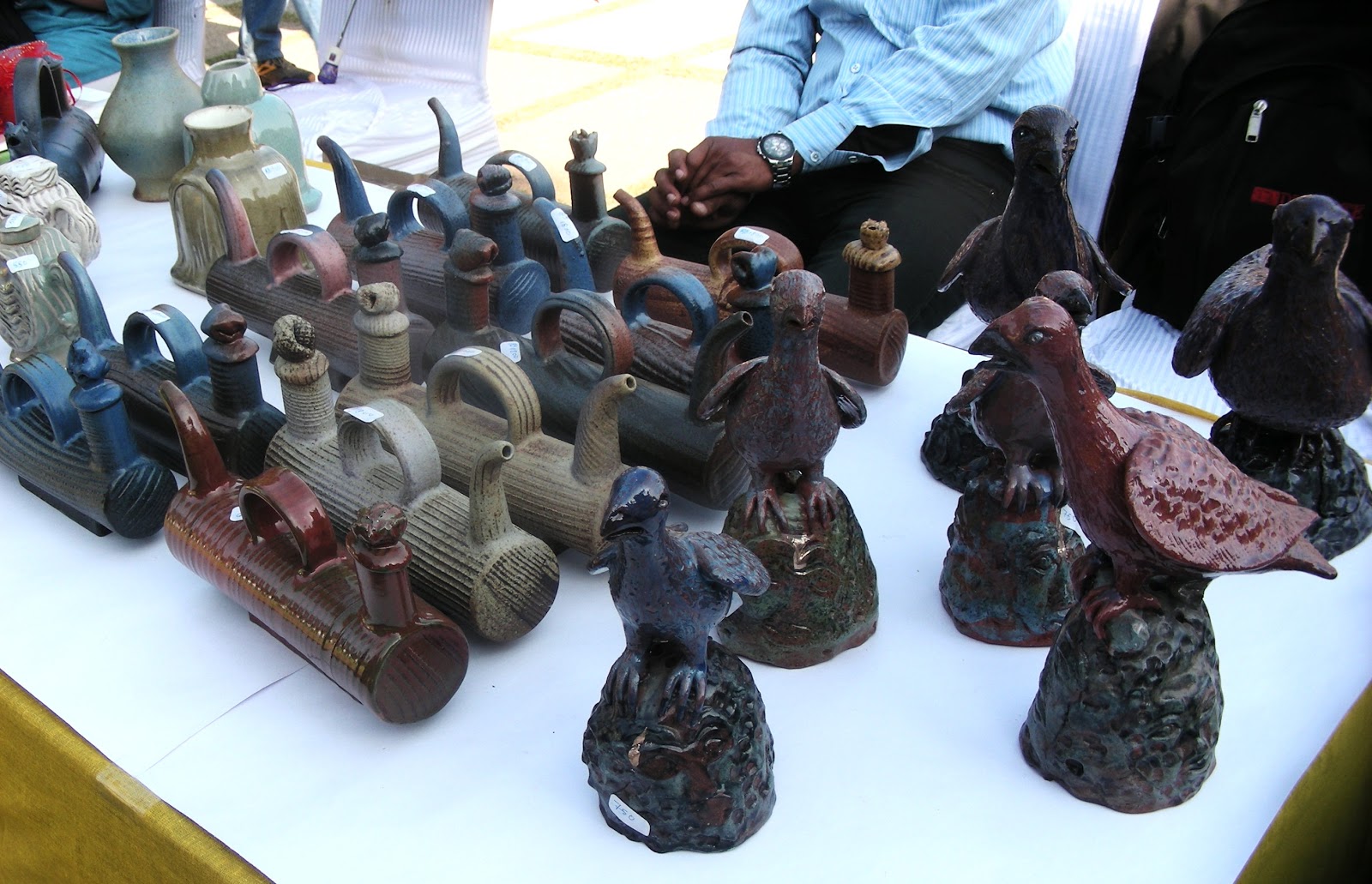
Delhi Blue Pottery Trust organized second edition of its Annual Potter's Bazaar on the lawns of charming Sanskriti Kendra at Anandgram, Delhi in the first week of December. Like the first edition, this year too the haat provided a platform to 40 odd studio potters to showcase their artistic creations to a large number of visitors. The event not only provided a wide spectrum of studio pottery on display and sale but also opportunity for the visitors to learn Raku firing technique. The occasion also marked formal inauguration of the second pottery center of Delhi Blue Trust in Delhi at Sanskriti Kendra. Their home base still runs from Delhi Blue near Safdarjung flyover.

Some of the finest practitioners of studio pottery had assembled here. Racha Prasher, Ranjana Subberwal, Rekha Bajpe Aggarwal, Reyaz Badruddin, Jugal Kishore Sankhyan from Andretta Pottery, Leena Batra, Mona Vohra,  Indu Rao, Sonia Dhingra, Shehla Grewal and Rajendra Dangle among others participated in the Bazaar.

The venue itself is worth more than one visit to enjoy its charming and rich presentation of traditional pottery craft from India, gallery of daily household objects and fabrics. Here are some visuals from the Haat.

    Bazaar banner under the giant banyan tree at Sanskriti Kenda welcoming visitors

    Exquisite range of Lal Mitti series pottery by Reyaz Badruddin, the young master studio 
    potter who is an established name in studio pottery in India. His range of wood fired and
    anagama pottery is pride of any collection.


     Wide range of functional as well as decorative pottery items in amazing glazes and slips.

    Pottery in all shapes, sizes, glaze and slips on display

    Rekha Bajpe Aghgarwal's collection of Raku pottery
    Young potters like Tamanna Singh also caught attention
    Spoilt for choice! It was difficult to choose from the vast range of pottery available and none were priced
    above Rs.4,000- It was intended to make studio pottery attractive and affordable.
    Funky range of functional Tea Pots created by Sadan Kumar Thakur
    Time for some serious shopping. This one looks right for me
    
Display of Reyaz Badruddin's counter
                                                Way to the Museum of Terracotta

    Another counter with some fine glazed functional potteryware
    Reyaz, the master potter enjoying the admiration of his creations

    Pottery ware displayed at Rachna Parasher's counter 

    And the master potter herself looking after her counter display - Rachna Parasher
Bagfull of studio pottery for my home!
                              Newly inaugurated Delhi Blue Ceramic Centre
     View of the Sanskriti Kendra
                          Fine Raku potteryware by Rekha Bajpe Aggarwal
                                      Display area
                Another view of Display area
    Terracotta man with camera and birds - Open air display at Sanskriti Kendra
      Another view of Sanskriti Kendra